
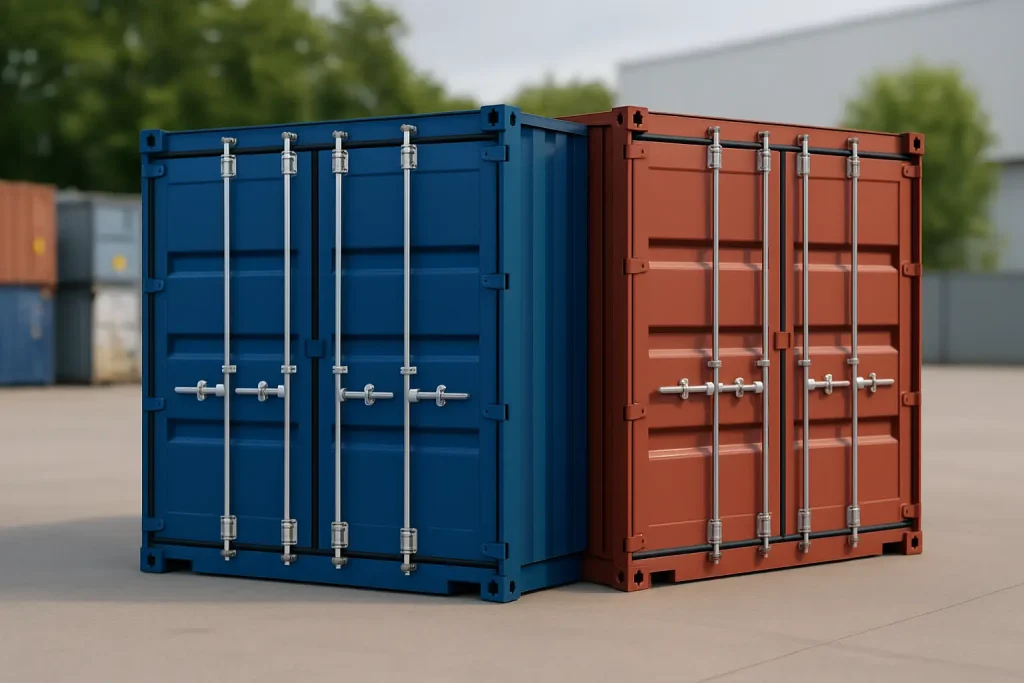
If you have ever tried to visualize your whole home as “cargo,” you already know the hardest part is not the packing – it is committing to the right amount of space. Pick too small and you risk last-minute upgrades, repacking, or splitting into multiple shipments. Pick too big and you pay for air.
For international moves in and out of Singapore, the 20-foot and 40-foot ocean containers are the workhorses. This guide breaks down the real decision behind 20ft vs 40ft container for moving – not just the size difference, but how that choice impacts cost predictability, loading strategy, timelines, and risk.
20ft vs 40ft container for moving: what changes in real life
A container is not just a box. It is a pricing unit, a loading plan, a customs inventory workflow, and a delivery constraint at destination. The “right” container size is the one that protects your goods, fits your access conditions, and keeps the shipment efficient.
A 20-foot container is typically the go-to for smaller households and partial-to-mid volume relocations. A 40-foot container is designed for full-family moves, larger homes, or relocations that include bulky categories like outdoor furniture, larger appliances, or extensive books and storage.
The trade-off is simple on paper: 40-foot gives you more volume. The trade-off in operations is more nuanced: larger containers can be more cost-efficient per cubic foot, but they require more disciplined packing, stronger load securing, and workable access for delivery.
How much can each container actually hold?
Most customers do not think in container dimensions. You think in bedrooms, wardrobes, and “do we keep the sofa?” That is the right instinct. But volume is what determines whether your shipment travels in a dedicated container or needs an alternative approach.
A 20-foot container is commonly suitable for a one- to two-bedroom home, depending on how furniture-heavy the household is and how much you are bringing. A 40-foot container is commonly aligned with a three- to four-bedroom household, or a two-bedroom home with unusually high volume.
What changes the math quickly is density and awkward items. A home with minimal furniture but many boxes can load efficiently. A home with fewer boxes but large sectional sofas, gym equipment, or oversized mattresses can “fill” a container earlier than expected because those pieces consume space that cannot be compacted.
If you are moving from the US to Singapore (or the reverse), also factor lifestyle differences. Many expats in Singapore use built-in cabinetry and smaller rooms, while US homes often have larger furniture footprints. That can push a “typical” household into the next container size.
The cost question: why bigger is not always “more expensive”
Container pricing is not linear. Yes, a 40-foot container costs more than a 20-foot container as a product. But your actual cost per usable cubic foot often improves with a 40-foot if you truly use the space.
The key is utilization. If you are at 80 to 95 percent of a 20-foot container, you are in a danger zone. One extra wardrobe carton, one additional mattress, or one late decision to keep the dining set can trigger a change in plan. That can mean delaying load day, reworking the packing list, or paying for a second shipment type.
If your projected volume is closer to the middle of a 20-foot, you usually have better cost control. If you are consistently beyond a 20-foot, a 40-foot can reduce the “multiple shipment penalty” where you pay separate origin handling, documentation processes, and destination delivery fees for split consignments.
There is also a practical budgeting truth: relocation costs are not just freight. Packing labor, materials, handling, export documentation, customs clearance, and delivery conditions can be significant line items. Choosing the container that reduces repacking and re-handling often reduces total risk and total cost, even if the container itself looks more expensive.
Load planning: the hidden difference between 20-foot and 40-foot
A 20-foot container is shorter, which can make load planning more straightforward. The team can build a stable “wall” of cartons and furniture, and the distance to the front is smaller, so it is easier to maintain tight packing and consistent securing.
A 40-foot container creates more opportunity – and more responsibility. The extra length means more sections to block and brace. If loading is not engineered properly, items can shift over long ocean legs, especially when the container experiences vibration, tilt, and stacking pressures.
This is why professional export packing and load securing matter more as volume grows. Your shipment is not just moving across a city. It is moving across borders, through ports, cranes, vessel schedules, and final-mile delivery teams. A 40-foot container loaded without a strict plan can turn into a damage claim that could have been avoided.
Access and delivery constraints you should not ignore
Customers often decide container size based on “how much fits,” then discover the real constraint is the destination.
Ask these questions early:
- Can a full-size container truck access the pickup and drop-off addresses?
- Are there tight turns, loading bays, height restrictions, or condo rules?
- Is there a time window for loading or unloading at your building?
A 40-foot container can be harder to position in constrained streets or dense residential areas. If access is limited, you may need a transload plan, shuttle vehicle, or alternate delivery method. These are solvable problems, but they must be scoped upfront so your schedule and budget stay stable.
A 20-foot container is often easier to handle in tighter environments. That flexibility can matter in city centers, older neighborhoods, and certain building-managed properties.
Timing and scheduling: what changes with a larger container?
On the water, a 20-foot and 40-foot container generally move within the same vessel networks. The difference tends to show up in readiness and handling.
A 40-foot load often involves more packing time, more inventory complexity, and more loading time. That can affect your preferred move date if you are trying to align with a flight, school start, or lease handover. It can also affect how early you need to confirm the booking.
At destination, unloading a 40-foot container can require longer labor time and stricter coordination with building management. If your delivery location has limited elevator access or strict booking windows, that needs to be planned as a controlled operation, not treated like a routine drop-off.
When a 20-foot container is the right call
A 20-foot container is a strong fit when you are moving a smaller household, downsizing, or shipping a defined set of items with clear boundaries. It is also a practical choice when you want a dedicated container experience without overcommitting.
It can be especially effective for:
- One- to two-bedroom households with standard furniture sets
- Couples or small families who have already decluttered
- Moves where access is tight and a smaller container improves feasibility
A 20-foot container also tends to keep decision-making disciplined. When space is tighter, you are less likely to keep “maybe” items that add cost without adding value.
When a 40-foot container is worth it
A 40-foot container makes sense when the household volume is clearly beyond a 20-foot, or when splitting the shipment would create more cost and complexity than simply sizing up.
It is usually the better operational choice for:
- Three- to four-bedroom homes
- Families relocating long-term with full furnishings
- Households with bulky categories like outdoor sets, large sectionals, or extensive storage
- Moves where you want one controlled shipment, one clearance process, and one delivery execution
If you are relocating for a multi-year assignment or permanent resettlement, the 40-foot option often aligns with the goal of restoring “normal life” quickly. It reduces the need to repurchase essentials on arrival.
The biggest mistake: choosing based on bedroom count alone
Bedroom count is a starting point, not a container-sizing method. Two homes with the same number of bedrooms can have radically different shipment volumes.
Here is what typically drives surprises:
- Home office equipment, monitors, and filing
- Books, vinyl, and collections (dense and heavy)
- Garage items like tools, bikes, sports gear, and storage bins
- Kitchenware and small appliances that multiply in cartons
If you are even slightly unsure, treat container selection as a volume assessment exercise, not a guess. A consultative mover that understands both household packing and freight planning can protect you from the common trap: planning for a 20-foot, packing into it on paper, then discovering the last 15 percent of your home is still on the floor.
A practical way to decide without overthinking it
If your estimated shipment is comfortably within a 20-foot, book the 20-foot and keep your scope tight. If you are hovering near the top end of a 20-foot, stop and make a strategic decision: either commit to reducing volume (sell, donate, or store) or move up to 40-foot to protect the timeline.
If you are clearly above a 20-foot, a 40-foot container is usually the cleanest plan: one pickup cycle, one loading plan, one ocean leg, one clearance flow, one delivery. That consistency is what expats and corporate mobility teams pay for.
If you want the decision handled with structured planning, Astro Movers (https://www.astro-movers.com) provides end-to-end international move management – from volume scoping and export packing to container loading, ocean freight coordination, and customs clearance support.
Choosing between a 20-foot and 40-foot container is not about guessing what fits. It is about controlling the move so your goods arrive protected, your schedule stays intact, and you do not spend your first week in your new country solving problems that should have been solved at origin.
