
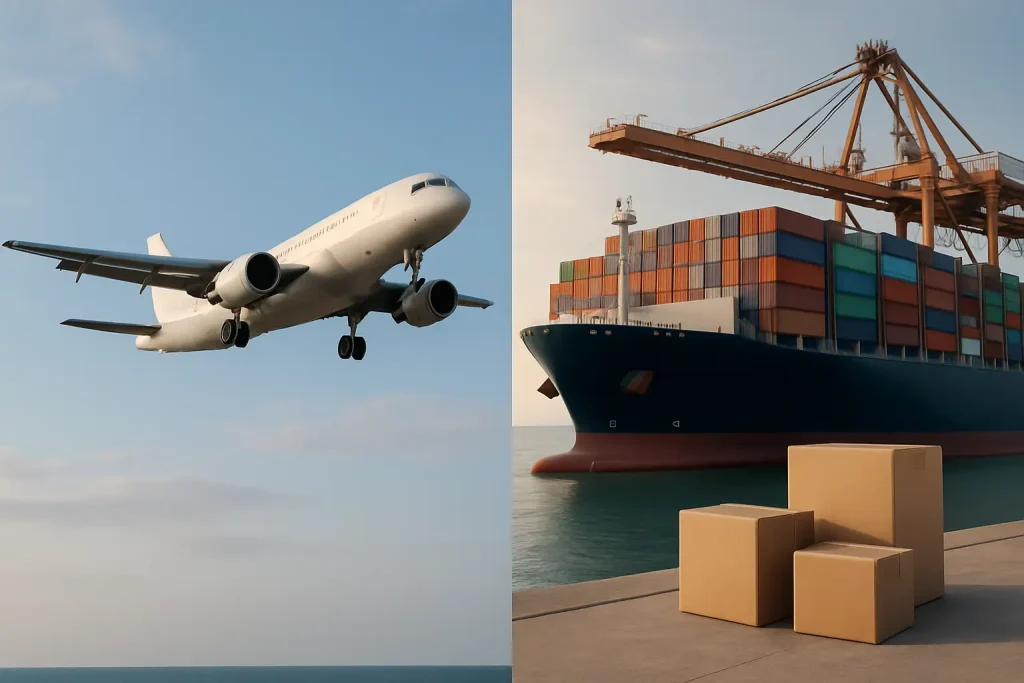
The day you realize your new start is tied up in boxes is the day freight stops feeling abstract. Your documents, kids’ essentials, work setup, winter coats, and the coffee maker you refuse to replace all have one job: arrive when you need them, intact, and with zero customs drama.
When clients ask us to break down air freight vs sea freight for moving, we don’t give a one-size-fits-all answer. We map the move around your timeline, your inventory, and the country rules that can turn “simple” into “stuck at port.” Here’s how to choose with clear trade-offs and logistics reality.
The real decision: time, volume, and predictability
Most international moves come down to three variables.
First is time. If you’re landing in a new city and need daily-life items quickly, speed becomes the controlling factor.
Second is volume. A few cartons and personal effects behave very differently than a full household with furniture.
Third is predictability. People assume air is always predictable and sea is always chaotic. In practice, predictability comes from planning: correct packing, complete paperwork, compliant item lists, and a shipping schedule that matches the receiving country’s processes.
Air freight and sea freight can both be reliable when they are managed like freight, not like wishful thinking.
Air freight for moving: what it’s best at
Air freight is designed for urgency and smaller shipments. If you’re moving for a job start date, school enrollment, or a corporate assignment with fixed reporting timelines, air is the tool that protects your schedule.
In many moves, air freight is not the “move everything” option. It’s the “start living immediately” option. Think of the items you can’t wait weeks to access: clothes for the current season, basic kitchen gear, essential baby items, prescription-related needs (when permitted), and the work equipment that keeps you productive.
Air freight also reduces the time your items spend in transit, which can reduce exposure to humidity and long dwell times. That said, air shipments still require professional packing and proper labeling. Faster shipping does not forgive weak cartons, poor cushioning, or unclear documentation.
Typical timing and how to think about it
Air freight is generally measured in days, but your real timeline includes more than flight time. You need packing time, export handling, airline booking, customs clearance on arrival, and delivery scheduling.
If your goal is “I need it next week,” air freight can often support that, but only if the shipment is prepared correctly and the receiving country’s customs requirements are met the first time.
Cost reality: you pay for speed and density
Air freight costs are usually driven by chargeable weight, which considers both actual weight and volume. Light but bulky items can become expensive quickly. This is why shipping pillows, large plastic storage bins, or low-value bulky household items by air rarely makes sense.
Air becomes cost-justified when the value of time is higher than the shipping premium or when the shipment is compact and essential.
Sea freight for moving: what it’s best at
Sea freight is built for volume and cost efficiency. If you’re relocating a full household, shipping furniture, or moving the kind of quantity that would be cost-prohibitive by air, ocean freight is typically the backbone of the move.
It’s also the right choice when you can tolerate a longer lead time and you want a controlled packing and loading process that protects bigger items for a long journey.
For Singapore-based moves to major expat corridors, containerized shipping is the standard for a reason. It scales well, it’s widely supported by destination ports, and it keeps your costs aligned with the size of your shipment.
Your main choices: full container vs shared container
For household moves, sea freight usually comes in two operational formats. A full container load is used when your shipment justifies a dedicated container. A shared container (often called groupage or consolidated shipping) combines multiple customers’ shipments.
A shared container can be cost-effective for partial moves, but it introduces more scheduling dependencies, because the container often waits for other shipments to be packed and loaded. If your timing is tight, this matters.
Timing reality: sea freight is planned time
Sea freight is measured in weeks, but the most important thing to understand is that ocean schedules have more moving parts: port cutoffs, vessel rollovers, transshipment connections, and destination port congestion.
This is not a reason to avoid sea freight. It’s a reason to plan it with discipline and give yourself a buffer. If your new lease starts on a fixed date, the smartest approach is often to ship by sea early and use a small air shipment to bridge the gap.
Air freight vs sea freight for moving: cost, speed, and risk
Speed is the obvious difference, but it’s not the only one that affects your move.
Air is faster, but more sensitive to how items are measured and classified. Sea is slower, but more forgiving on cost per cubic foot and better suited to furniture and large household goods.
Risk is not simply “sea is riskier.” Risk usually shows up as handling damage, moisture exposure, and customs holds.
Handling damage comes down to packing standards and load stability. A professionally packed air shipment can still get damaged if cartons are under-strength or if fragile items are poorly protected. A sea shipment can travel safely for weeks if it is packed for vibration, stacking pressure, and long-duration movement.
Moisture is typically a bigger concern at sea due to longer transit time and container environments. Proper materials, correct wrapping, and moisture-control strategies are part of competent ocean move planning.
Customs holds can happen with either mode. The common trigger is paperwork mismatch: missing documents, unclear valuation, prohibited items, or inaccurate inventory descriptions.
The customs and documentation factor (the part most movers underestimate)
International moving is not only transportation. It’s compliance.
Whether you ship by air or sea, customs agencies care about what you’re importing, why, and whether you meet eligibility rules for duty relief. Some destinations require detailed packing lists with item descriptions, values, and quantities. Others apply strict rules to electronics, alcohol, food items, plants, wooden articles, and medications.
Air freight sometimes feels simpler because the shipment is smaller and moves faster. But if customs flags it, speed disappears. Sea freight can look slow, but if the documentation is correct and filed on time, the clearance process can be smooth.
The practical takeaway: choose your freight mode after you confirm your documentation pathway. If you’re unsure what your destination will require, get that clarity before you finalize the shipping plan.
Use cases that make the decision easy
If you’re moving just a few items, air freight is often the right answer, especially when those items are truly essential and you want them shortly after arrival.
If you’re moving a full household, sea freight is usually the foundation. It’s how you move furniture, books, kitchenware, and the bulk of your home without paying air rates for cubic volume.
If you’re relocating with a firm start date but also shipping a household, a split shipment is commonly the most controlled approach. You fly in with luggage, send a compact “life support” shipment by air, then bring everything else by sea on a schedule that matches your housing and delivery availability.
How to choose without second-guessing
Start by organizing your inventory into two categories: what you must have immediately and what you can live without for several weeks. This sounds simple, but it prevents expensive mistakes like air-shipping low-value bulk.
Next, be honest about your delivery point. Are you moving into a serviced apartment, temporary housing, or a permanent home? If you don’t have a stable delivery address, sea freight may require storage planning. Air freight may still be workable for a small shipment delivered to a temporary address, depending on local rules.
Then pressure-test your timeline. If your job, school, or corporate reporting date is fixed, build backward from that date and leave buffer for customs and local delivery scheduling.
Finally, treat packing as part of the shipping decision, not an afterthought. Air and sea have different stress profiles, but both require professional export-grade packing if you want predictable outcomes.
If you want one accountable partner to manage packing, freight booking, customs documentation, and delivery coordination across 900+ destinations, Astro Movers builds air, sea, or split-shipment plans around your dates and your inventory, not generic assumptions. You can start with a quote at https://www.astro-movers.com.
The choice that protects your move
The best freight mode is the one that supports your actual life on arrival. If you need speed, pay for speed where it matters and keep the shipment tight. If you need value and volume, plan sea freight early and pack like your belongings deserve a professional standard.
A well-managed move isn’t defined by air or sea. It’s defined by a plan that makes your first week in your new country feel normal, not improvised.
