
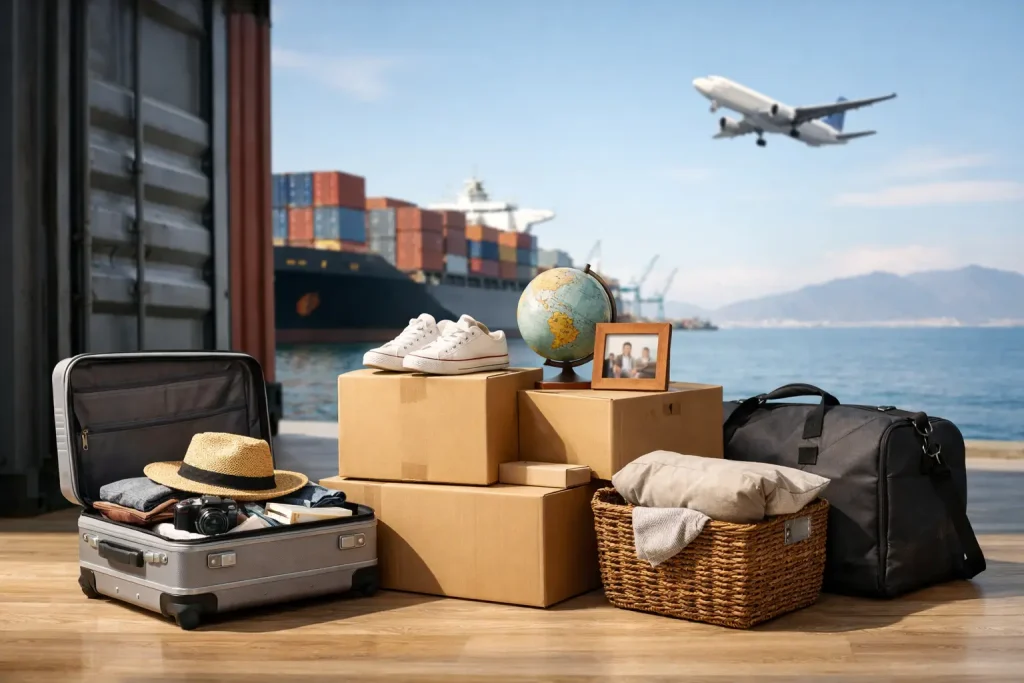
When a move date is fixed and your household is split between what flies with you and what follows later, the question becomes practical fast: what is the best way to ship personal effects overseas without wasting money, missing documents, or exposing your belongings to avoidable damage? The right answer is rarely a single shipping method. It is a managed plan built around volume, timeline, customs requirements, and how much responsibility you want to carry yourself.
What the best way to ship personal effects overseas really means
For most international moves, the best option is not simply the cheapest freight rate or the fastest transit. It is the shipping approach that protects your goods, matches your schedule, and clears customs cleanly at origin and destination. That usually means choosing between air freight, sea freight, or a combined solution, then pairing that with professional export packing, accurate documentation, and destination delivery coordination.
This is where many people underestimate the move. Shipping personal effects overseas is not the same as mailing boxes internationally. Once you are moving furniture, fragile items, electronics, or a family household, packing standards, inventory control, customs declarations, and last-mile handling matter just as much as the vessel or flight itself.
Start with the shipment size and urgency
The best way to ship personal effects overseas depends first on two variables – how much you are sending and how quickly you need it.
Air freight works best for urgent, smaller shipments
If you are shipping a limited number of boxes, essential clothing, children’s items, work materials, or high-priority household goods, air freight is often the smartest choice. Transit is much faster, and that matters when you are arriving in a new country and need immediate access to daily-use items.
The trade-off is cost. Air freight is significantly more expensive per kilogram or per cubic foot than ocean freight. It makes sense for partial moves, a few personal effects, or time-sensitive shipments, but it is rarely the most cost-effective solution for a full household.
Sea freight is usually best for full or larger moves
For larger household relocations, containerized ocean freight is typically the best way to ship personal effects overseas. It offers far better value for volume and is the standard choice for furniture, appliances, and long-form household shipments.
Sea freight does require more planning. Transit takes longer, sailing schedules can shift, and delivery timelines depend on port handling and customs release. But when the move is organized properly, ocean freight gives you the most efficient balance of cost and capacity.
A combined move often makes the most sense
Many overseas moves are best handled in two parts. Essential items go by air. The rest of the household goes by sea. This avoids overpaying to rush everything while still making sure you have what you need when you arrive.
For professionals relocating on assignment or families resettling before school starts, this split-shipment approach is often the most practical answer. It protects both the timeline and the budget.
Packing is not a side task
A lot of shipping problems begin before cargo ever leaves the home. If you want the best way to ship personal effects overseas, start by treating packing as a logistics function, not a weekend chore.
International shipments go through repeated handling points – pickup, loading, export processing, containerization, port handling, customs inspection, deconsolidation, and final delivery. Every transfer increases the risk of compression, shifting, abrasion, or breakage if goods are not packed to export standard.
Professional packing adds discipline where self-packing often creates uncertainty. Cartons are selected for the item type, fragile goods are cushioned properly, furniture is wrapped for transit, and the inventory is documented in a way that supports customs and claims. That consistency is one of the biggest differences between a controlled overseas move and a stressful one.
Self-packing can reduce upfront cost, but it may create claim limitations, customs complications, or repacking delays if standards do not meet carrier or destination requirements. For low-value clothing and non-breakable items, self-packing may be acceptable. For full household moves, high-value items, and anything fragile, professional packing is the safer call.
Customs can make or break the move
The freight mode gets attention, but customs clearance often decides whether a shipment feels smooth or chaotic. The best way to ship personal effects overseas includes planning for destination rules before the shipment is booked.
Different countries have different import conditions for used household goods and personal effects. Some require residence permits, visas, proof of relocation, detailed packing lists, or passport copies. Some apply restrictions on alcohol, food, plant material, wooden items, electronics, or new goods still in original packaging. Some allow duty-free entry only under specific residency conditions.
This is why documentation should never be an afterthought. A missing signature, vague inventory description, or incorrect declaration can lead to inspections, storage charges, or release delays. Experienced international movers manage this risk by aligning packing lists, shipment type, customs paperwork, and destination handling from the start.
For first-time expats, this support is often the difference between a routine delivery and weeks of uncertainty.
Choose service scope, not just shipping mode
People often ask whether the best option is air or sea, but the better question is how much of the move should be professionally managed. International shipping is only one part of the chain.
Port-to-port looks cheaper until the gaps show up
A port-to-port shipment may appear cost-effective on paper, but it leaves major responsibilities with the customer. You may still need to arrange export packing, inland pickup, customs documentation, destination clearance, port charges, and final delivery. For experienced shippers, that may be manageable. For households and relocating families, it often creates hidden cost and unnecessary exposure.
Door-to-door gives you one accountable process
For most personal effects shipments, door-to-door service is the better model. It creates continuity from survey and packing through freight booking, customs handling, and final delivery. Instead of coordinating multiple vendors, you have one structured move plan and one accountable partner overseeing the shipment.
That matters when schedules change, documents need correction, or delivery access must be arranged at destination. A provider with both moving and freight-forwarding capability can control more of the process, which reduces handoff risk.
Insurance is part of the shipping strategy
Even well-managed shipments involve long transit routes and multiple handling stages. If you are moving valuable personal effects overseas, insurance should be viewed as protection, not an optional extra.
This is especially true for full household moves, high-value electronics, artwork, antiques, or items that would be costly or difficult to replace abroad. The cheapest move is not the best move if a single incident turns into a major personal loss.
Insurance also pushes better discipline into the process. Accurate inventories, declared values, and professional packing all support stronger shipment control. It is part of responsible move planning.
Timing matters more than most people expect
The best way to ship personal effects overseas is usually the method you book early enough to execute properly. Last-minute moves limit routing options, compress packing schedules, and increase the chance of documentation errors.
If you are relocating for work, school, or a family transition, begin with a volume assessment and target delivery window. That helps determine whether you need lift-vans, shared container space, a full container load, or an air freight segment for immediate-use goods.
Early planning also helps with destination-specific restrictions, building access coordination, and storage decisions. In some cases, temporary storage at origin or destination is the right move if housing dates do not line up. A well-run relocation plan should allow for that without disrupting the rest of the shipment.
So what is the best way?
For a few essential items and a tight timeline, air freight is usually the best way to ship personal effects overseas. For a full household and better cost efficiency, sea freight is usually the right answer. For many relocating professionals and families, the strongest solution is a combined move with expert packing, customs coordination, insurance support, and door-to-door delivery under one provider.
That is why the real decision is not just freight mode. It is whether your move is being managed as a series of disconnected tasks or as one controlled international relocation. A trusted name like Astro Movers is built for the second approach – protecting your belongings, organizing the documentation, and keeping the move on track from consultation to final delivery.
If you want your overseas shipment to arrive with fewer surprises, start with a plan that matches your volume, timeline, and destination rules. The best moves are not improvised. They are managed carefully from the first carton packed to the last item placed at delivery.
