
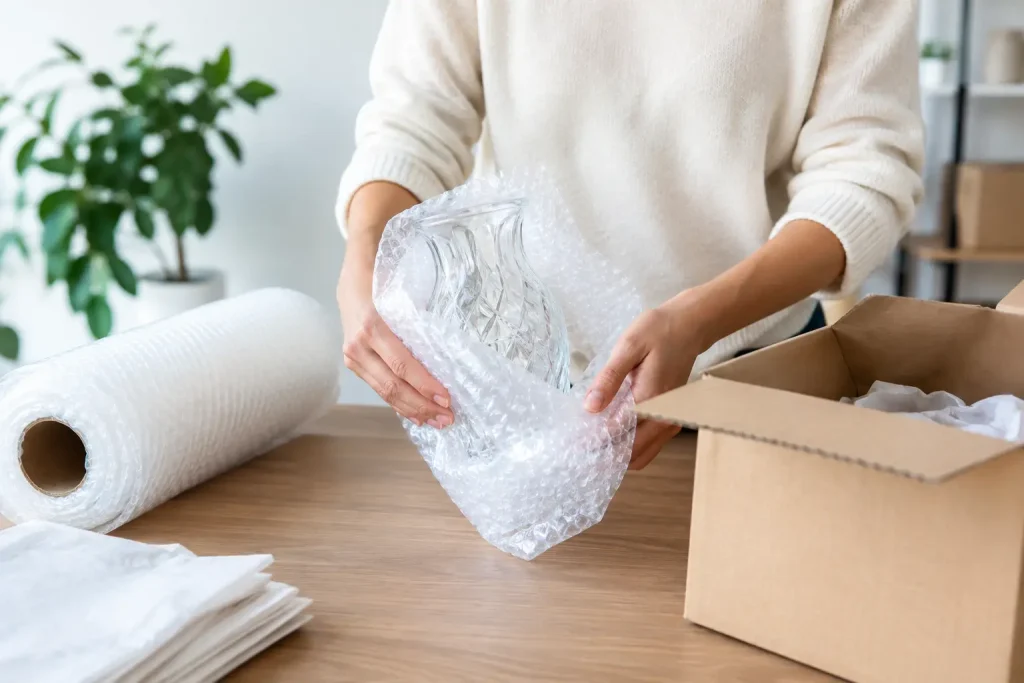
A wine glass can survive a long international journey. A poorly packed wine glass may not survive the first transfer between trucks. When customers ask how to pack fragile items for shipping, the answer is never simply “use bubble wrap.” Safe shipping depends on choosing the right carton, creating controlled cushioning, preventing movement inside the box, and matching the packing method to the freight route.
For an international move from Singapore, fragile belongings may be handled several times before final delivery. They can move from residence to warehouse, through export processing, onto an aircraft or container, through customs, and onto a destination delivery vehicle. Each handoff makes disciplined packing more important. The goal is not just to wrap an item. It is to build a protective system around it.
Start With the Item, Not the Box
Different fragile items fail in different ways. Glassware usually cracks from contact and pressure. Plates chip along their rims. Electronics can be damaged by vibration, moisture, or a sudden impact. Artwork and mirrors are vulnerable at corners and across their flat surfaces. Before packing, identify what the item is made of, where it is weakest, and whether it has moving or removable parts.
A delicate lamp, for example, should be separated into components where possible. Remove the bulb, shade, finial, and detachable fittings. Pack the base, shade, and hardware separately rather than trying to protect the assembled lamp in one oversized box. The same principle applies to framed art, small appliances, display pieces, and furniture with glass inserts.
If an item is exceptionally valuable, antique, oversized, or irreplaceable, standard household packing may not be enough. A custom crate, fitted foam, or specialist handling can be the better decision. This adds cost and space, but it reduces risk where replacement is not a realistic option.
Use the Right Packing Materials
Strong materials make a measurable difference, especially for ocean freight and long-haul relocations. Reused cartons may be suitable for lightweight, non-fragile belongings, but they are a poor choice for crystal, ceramics, or electronics if they are soft, damp, creased, or weakened at the seams.
For most fragile shipments, prepare these materials before you begin:
- Double-wall cardboard cartons in several sizes
- Clean packing paper and bubble wrap
- Corrugated cardboard sheets or dividers
- High-quality packing tape and a permanent marker
- Foam corners, stretch wrap, or crumpled paper for specialized items
Packing paper protects surfaces and fills empty spaces. Bubble wrap provides impact absorption. Corrugated sheets create separation and help distribute pressure. These materials do different jobs, so relying on only one of them creates gaps in protection.
Avoid using newspaper directly against delicate items. Ink can transfer to ceramics, glass, light-colored upholstery, and polished surfaces. Also avoid packing peanuts as the main protection for heavy objects. They shift under weight and do not stop a dense item from moving through the carton.
How to Pack Fragile Items for Shipping Step by Step
Begin by preparing the carton. Tape the bottom seam with multiple strips of quality packing tape, including a strip across the center and strips along the edges. For heavier fragile items, reinforce the bottom with an additional cardboard layer before adding cushioning.
Create a cushion at the base of the carton using crumpled packing paper, foam, or a padded cardboard insert. This base layer should absorb a drop or impact without allowing the item to touch the carton wall. Then wrap each item individually. Start with packing paper for surface protection and add bubble wrap where greater shock absorption is needed. Secure wrapping with tape, but do not apply tape directly to finished surfaces.
Place heavier items at the bottom and lighter items above them. Keep each item separated so glass, ceramic, metal, and wood do not rub together during transit. For plates, pack them vertically on their edges, not flat in a stack. Their rims are better able to withstand pressure when supported this way. Use cardboard dividers or thick paper layers between every plate.
Glasses and stemware need special attention. Wrap the stem first, then fill the bowl with soft paper before wrapping the entire piece. Place each glass upright in a divided carton if possible. If dividers are unavailable, build separation with tightly packed paper and ensure no glass can shift toward another piece.
Once the box is full, test it before sealing. Gently move the carton from side to side. If you hear or feel movement, add more void fill. A properly packed fragile carton should feel firm and stable, not overstuffed or loose. There should be cushioning on all six sides: bottom, top, front, back, and both sides.
Seal the top with the same care used on the bottom. Label the carton with its room, general contents, and handling instruction such as “FRAGILE” or “THIS SIDE UP” where appropriate. These labels help handlers identify the carton, but they do not replace proper internal protection. A box must be able to withstand normal freight handling even if it is briefly placed in an unfavorable position.
Pack Common Fragile Items Differently
Flat-screen televisions, monitors, and similar electronics are best transported in their original packaging when it is still in good condition. If that packaging is unavailable, use a purpose-built TV carton with foam corners and a protective screen cover. Never lay an unprotected screen against hard cardboard or stack heavy cartons on top of it.
For mirrors, framed artwork, and glass tabletops, protect the face with clean paper or a non-abrasive layer, reinforce the corners, and sandwich the item between rigid cardboard sheets. Larger pieces may require a custom crate. Tape a large X across exposed glass only if the item is already protected and the tape will not damage the surface. The tape may help contain fragments if breakage occurs, but it does not prevent impact damage.
Ceramics, figurines, and collectibles need generous individual wrapping, particularly around handles, spouts, protruding details, and lids. Pack lids separately from their matching containers. For hollow items, fill the interior with soft paper before wrapping the exterior.
For small appliances, remove loose accessories and pack them in labeled bags. Protect knobs, displays, and glass panels with cardboard or foam. If the appliance is heavy, use a smaller carton that can be lifted safely rather than a large box with too much weight concentrated at the bottom.
Consider the Shipping Method and Destination
Air freight is generally faster, but speed does not eliminate handling risk. Ocean freight may involve longer transit times, humidity changes, and extended movement inside a container. For containerized shipments, cartons should be professionally loaded, secured, and protected from shifting across the full load. Fragile boxes should not be used as a foundation for heavy furniture or appliances.
Destination requirements matter as well. Customs authorities may inspect cartons, and vague labeling can slow clearance. Maintain a clear inventory with accurate descriptions and declared values where required. Do not pack prohibited goods or undocumented items inside cartons marked as household effects. A well-packed box can still create a problem if the documentation does not match its contents.
Insurance is another practical consideration. Transit coverage can help when a covered incident occurs, but it does not make poor packing acceptable. Some policies have packing conditions, valuation requirements, or exclusions for owner-packed cartons. If you are packing valuables yourself, confirm the terms before shipment rather than assuming every item is protected at full replacement value.
When Professional Packing Is the Better Option
Self-packing can work for a small number of low-risk items when you have the right materials and time. It becomes less practical when a household includes artwork, antiques, large electronics, designer furniture, chandeliers, or a high volume of glassware. It can also be difficult for families managing an international departure schedule, property handover, children’s school arrangements, and immigration paperwork at the same time.
Professional packers bring standardized cartons, protective materials, trained handling methods, and loading discipline. More importantly, they coordinate packing with the broader move plan: inventory preparation, freight booking, customs documentation, storage, and destination delivery. Astro Movers manages these moving parts under one accountable relocation process, so fragile items are not treated as an afterthought between packing day and shipment departure.
Before sealing your final carton, ask one simple question: if this box were tilted, stacked, and transferred several times, would every item remain separated and protected? If the answer is uncertain, add cushioning, use a stronger carton, or arrange specialist packing before the shipment leaves your home.
