
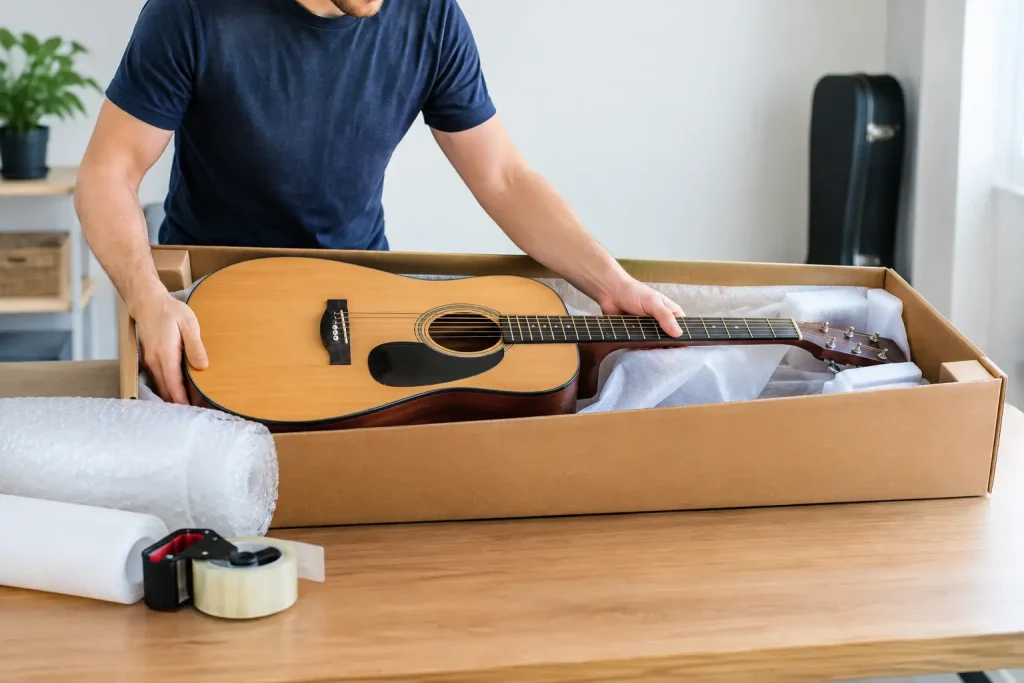
A guitar case can look secure and still fail under the pressure of an international move. Changes in temperature, handling at multiple terminals, customs inspections, and the weight of surrounding cargo can turn a small packing oversight into an expensive repair. This guide to shipping musical instruments explains how to protect valuable instruments from collection in Singapore through customs clearance and final delivery overseas.
For expats, families, and corporate transferees, the right approach depends on the instrument, its value, its materials, and how quickly it must arrive. A violin requires different protection from a digital piano, and a professional drum kit should not be shipped like ordinary household goods. Careful planning is what keeps the move controlled.
Start With the Instrument, Not the Shipping Method
Before choosing air freight or ocean freight, assess each instrument individually. Record the make, model, serial number, condition, replacement value, and any pre-existing marks. Take clear photographs of the front, back, sides, accessories, and case interior. This inventory supports insurance, customs documentation, and any future claim.
The instrument’s construction matters as much as its size. Acoustic guitars, cellos, violins, double basses, and wooden wind instruments can react to rapid shifts in humidity and temperature. Keyboards and amplifiers contain sensitive electronics. Brass instruments are more durable in some respects, but valves, slides, bells, and mouthpieces still need immobilization.
Ask three practical questions: Is the instrument irreplaceable or professionally used? Does it need to arrive by a fixed date? Will it travel alone, with a partial shipment, or as part of a full household move? The answers determine the packing specification, freight option, and insurance level.
Packing Musical Instruments for International Shipping
A hard case is a starting point, not the complete packing solution. Even a flight case can shift inside a carton or wooden crate if voids are not filled correctly. Professional export packing creates layers of protection: the instrument is stabilized in its case, the case is cushioned inside an outer container, and the exterior is prepared to withstand stacking and transfer handling.
For string instruments, loosen strings slightly to reduce tension during climate changes, unless the manufacturer or luthier advises otherwise. Secure loose accessories such as bows, rosin, capos, pedals, cables, and sheet music separately. Do not place heavy objects inside an instrument case, even if there appears to be space.
Wooden instruments benefit from stable humidity management. A suitable humidifier or desiccant may help, depending on the route and expected conditions, but it must be selected carefully to avoid moisture damage. Cases should be closed securely without forcing them shut. For high-value violins, cellos, guitars, and similar instruments, a custom crate may be the most responsible option.
Large instruments need specialized preparation. A piano may require disassembly of legs and pedals, protective wrapping for the body, and a purpose-built crate or skid. Drum kits should be broken down, with shells protected individually and hardware packed so it cannot strike delicate surfaces. Electronic keyboards need anti-static protection and strong corner reinforcement, particularly around keys, screens, and control panels.
Avoid relying on luggage, thin retail boxes, or generic bubble wrap for an international shipment. Those materials may be suitable for local transport, but they do not provide dependable protection through export loading, freight movement, unloading, and destination delivery.
Why professional packing is worth considering
Professional packers understand how freight is handled beyond the front door. They select materials based on the instrument’s shape, fragility, and shipping mode, then label packages clearly for inventory control. This is particularly valuable when your shipment contains multiple instruments, studio equipment, or a combination of household goods and professional gear.
Astro Movers coordinates packing, loading, freight arrangements, customs documentation, and destination delivery under one move plan. That single point of accountability reduces the risk of an instrument being treated as an afterthought within a larger relocation.
Choosing Air Freight or Ocean Freight
Air freight is usually the better choice when an instrument is needed quickly for a performance, school term, recording project, or work assignment. Transit is significantly faster, and the shipment may spend less time in variable storage conditions. The trade-off is cost, especially for bulky cases, pianos, drum sets, and amplifiers charged by dimensional weight.
Ocean freight is often more economical for a full household relocation or a large collection of instruments. It works well when schedules are flexible and the shipment can move in a consolidated load or dedicated container. However, ocean transit takes longer, and the cargo requires stronger moisture protection and export-grade crating where appropriate.
A partial shipment can be a practical middle ground. For example, an essential violin, guitar, or keyboard can travel by air, while less time-sensitive equipment moves with the household shipment by sea. The correct decision is not always about the lowest freight rate. It is about balancing timing, value, risk tolerance, and total move cost.
Customs Rules Can Affect Your Instrument
Many instruments cross borders without unusual restrictions, but materials and accessories can create customs complications. Certain woods, animal-derived components, ivory, tortoiseshell, feathers, and skins may be controlled or prohibited. Antique instruments can require additional proof of age, origin, or ownership.
CITES rules are particularly relevant for instruments containing protected species materials. A personal-use exemption may apply in some circumstances, but it is not automatic and destination-country requirements vary. Never assume that an older instrument is exempt simply because it has been used privately for years.
Prepare a detailed packing inventory with the instrument’s description, serial number, country of manufacture if known, and declared value. Keep purchase invoices, valuation reports, repair records, and ownership documents available. If an instrument contains regulated materials, obtain expert advice before booking freight. Incorrect declarations can lead to clearance delays, inspection, fines, or confiscation.
Professional customs management helps ensure documents match the physical shipment. It also gives you a clear process if customs officers request clarification or supporting records.
Insure for Replacement Value, Not Hope
Standard carrier liability is often limited and may not reflect the true cost of a professional instrument. Insurance should be discussed before packing and collection, not after a shipment is already in transit.
Declare an accurate replacement value based on current market pricing, not what you originally paid years ago. For rare, vintage, or professionally customized instruments, obtain a current appraisal. This is essential for proper coverage and makes any claims process more straightforward.
Read the coverage terms closely. Understand what applies to accidental damage, theft, water exposure, total loss, and mechanical or electrical faults. Also confirm any packing conditions. Some insurers will only cover fragile items when packed by approved professionals or shipped in specified containers.
Plan Delivery Before Your Shipment Leaves
The final mile can be as demanding as the international transit. Confirm whether the destination has elevator access, stair restrictions, loading bay booking rules, parking limitations, or building management requirements. A piano or large keyboard may require additional manpower and specialized equipment at delivery.
If your new home is not ready, secure storage that is appropriate for musical instruments. Climate-controlled storage is preferable for sensitive wood instruments and valuable electronics, particularly in humid regions. Avoid leaving instruments in garages, balconies, or unmanaged storage areas where heat and moisture can cause gradual damage.
On delivery day, inspect every case and crate before signing completion paperwork. Photograph any visible damage immediately and retain all packing materials until the inspection is complete. If an issue is found, report it promptly through the documented claims process.
A Controlled Move Protects More Than the Instrument
Musical instruments carry financial value, but they also carry years of training, work, and family history. The most effective shipping plan is built around that reality: accurate inventory, export-grade packing, the right freight mode, compliant documentation, and insurance that reflects the instrument’s true value.
Give the planning process the attention the instrument deserves. A well-managed international move lets your instrument arrive ready for its next rehearsal, performance, lesson, or new home.
