
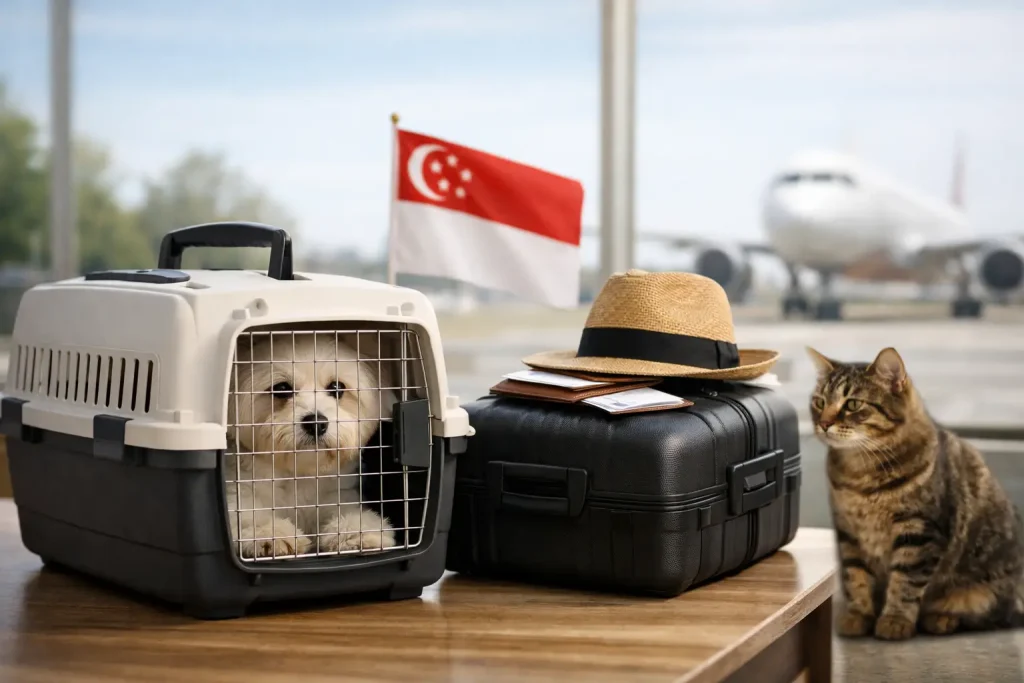
A family move gets complicated fast when a dog or cat is part of the shipment plan. People often assume pets can travel once flights are booked and a crate is purchased. In reality, international pet relocation Singapore requirements involve import permits, health documentation, vaccination timing, airline restrictions, and country-specific controls that can derail a move if handled too late.
For expats, returning residents, and corporate assignees, the risk is not just delay. A missed document window can mean quarantine changes, denied boarding, added storage, or costly rebooking. That is why pet relocation should be treated like any other regulated international shipment – with a schedule, compliance checks, and one clear chain of responsibility.
What international pet relocation Singapore requirements usually include
The exact rules depend on whether your pet is entering Singapore, leaving Singapore, or transiting through another country. They also change based on the pet type, the origin country, and sometimes even the airline. Still, most international pet moves involve the same core requirements.
You will typically need an import or export permit, a valid microchip, updated vaccinations, a veterinary health certificate, and a crate that meets airline standards. Some destinations also require blood tests, parasite treatments, import inspections, advance reservation on approved flight routes, or quarantine booking. If the pet is a snub-nosed breed, very large, elderly, anxious, or medically sensitive, additional transport restrictions may apply.
This is where many movers underestimate the process. Household goods can often be packed and shipped on a broader schedule. Pets move on a far tighter compliance timeline, and some documents are only valid for a few days.
Singapore pet relocation is heavily timing-driven
Singapore is known for strict border controls and structured import procedures. That is a good thing for biosecurity, but it leaves little room for error. If you are bringing a pet into Singapore, you may need to coordinate permit approval, vaccination records, lab testing, and inspection appointments in a specific order. If you are moving a pet out of Singapore, the receiving country may impose even tighter standards than Singapore itself.
Timing matters because vaccines cannot always be administered right before departure. Some countries require rabies vaccination to be done within a certain range before travel. Others require a rabies antibody test and a waiting period after the blood draw. Health certificates are also time-sensitive and usually need endorsement close to departure.
That means your relocation timeline should start months ahead, not weeks ahead. For straightforward corridors, a shorter lead time may work. For Australia, certain parts of Europe, or countries with stricter quarantine rules, the runway is often much longer.
The documents that most often cause delays
Paperwork failures are the most common reason pet relocations run into trouble. Usually, the issue is not that a document is missing entirely. It is that the details do not match.
A pet’s microchip number must align exactly across vaccination records, permit applications, lab reports, and health certificates. Names of owners and consignees also need to match the booking and customs documentation. Even small inconsistencies can create clearance issues.
The most common document set includes the pet owner’s identification, vaccination booklet or records, microchip details, veterinary certificates, permit approval, and travel booking confirmation. Depending on destination, you may also need laboratory results, import declarations, quarantine reservation confirmation, and proof that the crate meets transport standards.
Experienced relocation planning reduces this risk by checking the full document chain before cargo acceptance or airline handover. That level of coordination matters because once a flight window is missed, rebooking is not always simple.
Crate standards are not a minor detail
A compliant crate is not just a box for transport. It is part of the regulatory and airline acceptance process. Airlines can reject a pet at check-in or cargo acceptance if the crate is undersized, damaged, poorly ventilated, or not appropriate for the breed.
The crate must allow the pet to stand naturally, turn around, and lie down comfortably. Water access, secure fastenings, absorbent lining, and labeling are also important. For larger dogs, crate sizing becomes more technical because aircraft type and cargo door dimensions can affect whether the pet can be accepted on a specific route.
This is one of the biggest trade-offs in pet relocation. Owners want the most direct flight possible, but a direct routing is not automatically the safest or most practical. Depending on breed, season, and aircraft capacity, a different route with better airline handling conditions may be the better decision.
Airline rules can override your preferred plan
Many people are surprised to learn that airline rules can be stricter than destination country rules. A country may allow entry, but the airline may still refuse carriage for certain breeds, crate sizes, or weather conditions.
Snub-nosed pets are the clearest example. Brachycephalic dogs and cats often face additional restrictions because of breathing risk during transport. Some airlines will not carry them at all. Others only allow them on selected routes or during cooler periods. Temperature embargoes can also affect summer departures, especially for transit points with hot climates.
This is why pet relocation cannot be treated as an afterthought attached to a household move. Flight selection, routing, and document readiness all need to line up at the same time. A strong relocation partner looks at compliance and transport feasibility together, not as separate tasks.
Quarantine depends on origin, destination, and category
Quarantine is one of the first questions pet owners ask, and the honest answer is: it depends. Some pets entering Singapore may not need quarantine if all conditions are met and the country of origin falls into a lower-risk category. Others may require quarantine based on the source country, document status, or health compliance.
The same applies when relocating from Singapore to another country. Some destinations permit home isolation in limited cases. Others require a formal quarantine stay or pre-approved holding arrangements. If quarantine is required, the booking often needs to be secured early because space can be limited.
This is not an area to guess. Quarantine rules affect travel dates, cost, owner expectations, and the handover plan at destination. Getting this wrong can disrupt the entire relocation schedule.
How to prepare for international pet relocation Singapore requirements
The best approach is to treat pet relocation as a managed logistics project. Start by confirming the destination country rules, then work backward from the intended travel date. That helps identify when vaccinations, tests, permit applications, and veterinary appointments must happen.
Next, confirm the travel method. Some pets can travel as manifested cargo, while others may be eligible under different airline arrangements depending on route and carrier. Then validate crate size and route feasibility before finalizing flights. It makes little sense to complete all health preparation only to find the aircraft cannot accept your pet’s crate dimensions.
Owners should also prepare for practical arrival issues. Who will receive the pet? Is customs clearance handled on arrival? Is quarantine transport needed? Will the pet arrive before or after the family and household shipment? These details matter because pet moves and household goods moves do not always operate on the same schedule.
For families moving internationally, especially on assignment deadlines, it is usually more efficient to place the pet move under the same structured relocation plan as the rest of the shipment. That reduces handoff risk and gives you one accountable process instead of multiple disconnected vendors.
Why professional coordination makes a real difference
International pet transport is a specialized compliance exercise wrapped inside a time-sensitive move. The reason people use an experienced relocation company is not convenience alone. It is risk control.
A professional team can sequence permits, vet checks, crate preparation, flight coordination, and clearance planning so the move is not left to guesswork. This matters even more when a family is managing visas, school enrollment, lease deadlines, and container shipping at the same time. One missed step on the pet side can create more stress than a delayed carton of household items.
For Singapore moves, the strongest support comes from a provider that already handles cross-border logistics, customs processes, and structured relocation planning. That is where a company like Astro Movers fits naturally – not as a basic mover, but as a single accountable partner for complex international relocation.
If your pet is part of the move, start early and plan precisely. The right move is not the fastest quote or the shortest checklist. It is the one that gets your pet to the right country, on the right documents, with the right handling from departure to arrival.
